

The rise in demand for integrated ergonomic and technology workspace solutions has made piano stands shift from passive gear to vital accessories for musicians, producers, and hybrid workers alike. By 2025, 5 Core, Yamaha, K&M are seen to enhance their product lines, incorporating multi-functional and intelligent features along with other two value-adding attributes, i.e, robustness and flexibility. This analysis examines the relative merits and differences of these three major players in the industry and offers guidance for making educated choices in a complex and competitive environment.
The 2025 Piano Stand Landscape

The piano stand market will be ruled by clashing philosophies in modular adaptability, ecosystem integration, and industrial strength in 2025. In 2025, K&M, Yamaha, and 5 Core will each control different segments of the market, which will reflect the overall paradigm shift in the demand for workspaces. Smart connectivity, eco-friendliness, and ergonomics are increasingly becoming elements of value creation to be neglected at the peril of the brand. The focus on economy of weight and strength, ease of integration, and attention to the needs of the customer will guide the decision-making process for the amateur and professional user.
Comparison: 5 Core vs Yamaha vs K&M
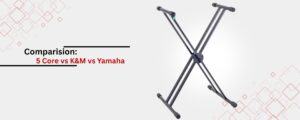
5 Core Stands: Innovation Collides with Modularity
5 Core is often praised for its modular design and innovative engineering. Its keyboard stands are equipped with lightweight carbon-fiber frames that are easy to transport but can support heavy weights. Furthermore, adjustability is taken care of by multi-axis tilt mechanisms with a built-in feature of angle customization anywhere between 0 to 40 degrees. For advanced users, the integrated wireless charging pads and Bluetooth connectivity for device pairing will surely catch their attention. Sustainability is also taken into regard, with up to 60 percent of construction being made out of recycled parts.
Key Features:
Additional modular features, like removable tablet mounts, secondary tiers, or additional accessories, are also available. The company’s app lets you set preset values for ergonomics or gives alerts for required movements via built-in motion sensors. The Stand is set to be priced in the mid-to-premium range, which is not surprising considering the technology level implemented.
Yamaha Piano Stands: Heritage and Precision
In Yamaha’s history of precise engineering, the brand has worked to ensure that everything functions with its own keyboard instruments without issues. The company has also modernized and upgraded its keyboard stand construction by utilizing reinforced aluminum alloys that digitally support heavy digital pianos. Changes in sitting or standing positions are made easy with adjustable height via hydraulic systems. The minimalist designs for the stands now come in matte black or brushed metallic finishes, which aesthetically integrate with Yamaha’s instruments.
Key Features:
As an added benefit, proprietary locking mechanisms are built into the stands and enable easy transport without risk of damage. Users of other devices within the Yamaha ecosystem will benefit, as it has direct MIDI connectivity on other devices, and knobs have the option to be used. The proprietary midrange to premium pricing offer targets loyalist consumers of the instrument ecosystem as well.
K&M Piano Stands: Reinforced Durability
In 2025, K&M has made a name for themselves in the industry and is known for their industrial-grade durability. The piano stands are made of powder-coated steel and reinforced polymers, which support over 35 kg in weight. The malleability of these high-quality materials is incorporated in the telescopic height adjustments and patented tilt lock systems that are suited to reduce set-up time and enhance ergonomics. Foldable designs with reinforced carry handles provide enhanced portability, which is ideal for touring musicians.
Key Features:
Whether you use mechanical or membrane keyboards, K&M piano stands use width-adjustable brackets. Universal compatibility of all sizes and styles of keyboards is a main focus. K&M also showcases their commitment to sustainability through further warranty extension as well as providing carbon-neutral production. The prices are set to be competitive, lying in-between low-end and high-end pricing.
Comparative Analysis: 5 Core vs. Yamaha vs. K&M

To help determine the best option, a critical side-by-side comparison is provided.
Design and Build Quality:
While 5 Core tends to their customers by offering lightweight carbon-fiber frames, Yamaha focuses on aluminum arms for effortless integration with their instruments. K & M offers the most steel and polymer frames, which are unmatched durable, albeit a little heavier to use.
Adjustability and Ergonomics:
5 Core leads in customizable tilt and smart features offered. While, Yamaha also holds an advantage with their smooth hydraulic height adjustments, allowing easy transition during use. Simplicity and reliability are also traits that can be attributed to K&M’s tilt lock and telescopic adjustments as well.
Compatibility and Portability:
K&M’s universal design offers broad compatibility, which makes them a winner in this category but the stand-neutrals offered by Yamaha only aid in their devices. Multi-device users will find 5 Core’s modular design more appealing but will have to purchase additional tech integrations.
Cost-to-Value Ratio:
According to my analysis, K&M appears to be the best priced option for heavy-duty users, while 5 Core defends its high pricing because of its advanced technologies. Yamaha appears to have mid-to-high pricing due to its brand reputation and specialized brand integrations.
Conclusion
In 2025, the piano stand market is led by 5 Core, Yamaha, and K&M, each of which pursues innovation in their own manner. 5 Core is changing the definition of flexibility with modular, tech-enabled designs suitable for transitioning hybrid workspaces. As ever, Yamaha offers precise engineering, drawing upon its history to craft stands that are specifically designed for integration within their ecosystem. K&M still stands for industrial economy, providing reliability without compromise for professionals working in constantly changing situations. All of these brands set the industry standard, but the evolution of piano stands still remains a mystery. Future innovations in material science, connectivity, and ergonomics may change modes of functionality and design beyond what is conceivable today. In a constantly shifting environment, the one unchangeable fact is that whatever decision is made with regards to the work types, user priorities will always have to be placed front and center.