
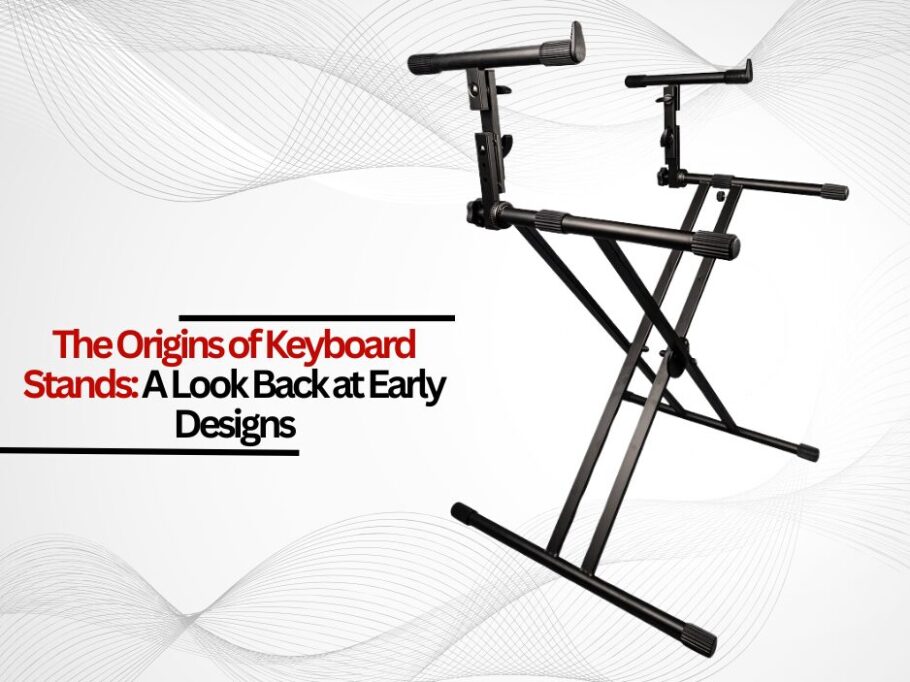
Alongside the development of sound systems and music systems, keyboard instruments also saw innovation – their physical support systems, referred to as keyboard stands, were no exception to this evolution. Ancestors of today’s musicians relied on very basic props that were mostly non-adjustable and rudimentary. Early musicians used ergonomic designs with keyboard stands that were functional, simple, and often crafted on the fly. Every transition in keyboard technology brought new stands to support evolving needs. Looking at the harpsichord, followed by the piano and modern electronic keyboards, all required construction that was durable.
This blog follows the evolution of early stand models, looking into how craftsmanship and materials, as well as musical demand, influenced the vintage designs that served as templates for modern innovations.
To know more, Read: Innovative Piano Stand Designs That Will Change the Way You Play in 2025
The Birth of Keyboard Stands

Turning Furniture into Support Structures:
Back in the 17th and 18th centuries, they had built-in ornamental keyboards like the harpsichord and the clavichord. Expensive households would have them sitting in their living rooms transforming into decorative items. Their use changed in the context of music since it became a lot more performative. Props changed with the aim to stand alone. Small wooden frames capable of laying lower props designed with basic carvability to elevate instruments were the initial frames designed intended for use during play.
Selecting Materials for Early Stands:
Sculpted from mahogany and oak, early stands were made of dense hardwood. Metal reinforcements like iron brackets were used to mitigate potential warping. These early designs, like the stands themselves, valued stability over portability, likely due to the stationary nature of aristocratic salon and church keyboards.
Standardization and the Industrial Revolution

Mass Production and Modularity:
The industrialization that came in the 19th century changed the industry of stand construction. Steel and cast iron became favorable materials because they allowed for multi-level height stands. Factories catered to touring pianists and theater musicians by creating early stand models with telescoping and collapsible legs.
The Increase in Popularity of the Upright Piano:
The compact, space-saving stands needed for the upright piano gained popularity in the late 1800s. Often engraved with decorations such as carvings and brass, the stands were typical of Victorian-era architecture. Design from this period is cherished by many and stands as a testament to the blend of beauty and function.
The Shift towards Portability

Impact of Electronic Keyboards:
With the emergence of modern electronic keyboards in the mid-20th century, the need for more compact and lightweight stands was evident. Early synthesizers, such as the Hammond organ and Rhodes piano, were accompanied by tubular steel frames (an early form of portable keyboard stands). These models were streamlined for ease of use, although they were still heavy compared to contemporary models.
The Experimentation with Lightweight Materials:
Aluminum and reinforced plastics started to appear in the construction of stands in the 1970s. Along with these changes, manufacturers started to use foldable X-shaped frames with detachable parts. This marked the creation of the first keyboard stands, shifting the industry’s focus from permanence to mobility.
Legacy of Vintage Stand Designs
Aesthetic Influences:
Many Vintage stand designs from the 20th century were designed with function in mind, but many also featured elements of beauty. Functional art took the form of 20th century vintage stands, which were decorated with decorative Art Deco geometric patterns and minimalistic Mid-Century Modern lines.
Functional Longevity:
Early stands, like all other vintage keyboard stands, were made to last. Their robust construction, featuring corrosion-resistant finishes, highlighted the craftsmanship of their respective eras, showing that parts built in later eras only added layers of value.
Conclusion
The development of keyboard stands captures the essence of progress in music, technology, and culture. The designs of early stands featuring bulky wooden frames transformed into modern elegant and modular systems. Ergonomic and portable solutions were built upon those vintage designs. Renowned brands like 5 Core, Roland, Yamaha, and K&M have not stopped and are still evolving keyboard support systems.
The future is unpredictable, but what is certain is that the core values of keyboard stand principles around strength, flexibility, and attractiveness developed throughout stand history will remain relevant. We can trust that the supporters of the future will honor this abundant history, supporting musicians in ways their predecessors could hardly fathom.