
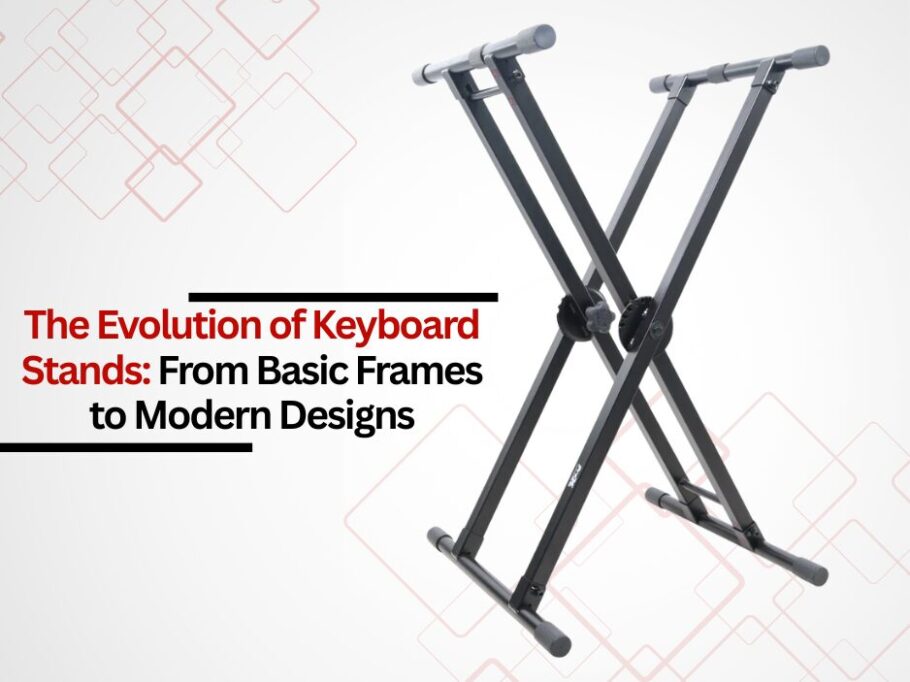
The growth of keyboard instruments is always connected to the evolution of their support systems. Rational discussions centered around the innovations of synthesizers, pianos, and electronic keyboards tend to overlook the considerable evolution of the stands which support these instruments. The history of keyboard stands is one of transformation, from basic frameworks to ergonomic designs tailored toward shifting artistic requirements and advancing technology.
To know more, Read: 5 Core, Yamaha vs. K&M Piano Stands in 2025: Which One Should You Choose?
The Early Stages: Prioritizing Stability

In the nineteenth and twentieth centuries, keyboard stands served a more static purpose. The grand pianos and church organs which dominated performances required heavy wooden or iron frames for adequate support. Early stands favored rigidity, as mobility was rarely needed. However, the mid-twentieth-century electric portable piano boom shifted these needs. Supports designed for gigs and studio sessions needed to be lightweight and collapsible. The introduction of basic X-shaped frames in the early 1960s began to meet this need. Crafted from steel tubing, these frames were anything but perfect. Lacking adjustability and prone to instability, their functional design highlighted a new need: portability. Despite their flaws, the stand design evolution marked a new phase in an ever-expanding live performance era.
The Changes in Focus Toward Flexibility and Ergonomics

With the explosion of synthesizers and workstations, by the 1980s their needs also included other instruments like keyboards. This is the time when Z-shaped designs first appeared, which had tiered structures to allow stacking of multiple keyboards. Custom-fit elbows and collapsible joints became standard to help the musician set up and customize for ease of use.
Ergonomics also improved uncontrollably. Adjusting to tilt and height was added to help these new keyboards serve a wider range of users. During these changes, the bulkier metals were also replaced by more lightweight aluminum. This was done in order to provide convenience in transportation for traveling musicians. All these changes helped boost the performance of the new Z stands.
The Needs of Professional Players:
Musicians on tours were a big force towards these innovations. Along with lots of ease of transport and setup, the new Stand needed to be more durable. Double-braced legs quickly followed along with reinforced locks and knee joints. Other improvements combined padding to contact points to protect the instruments. All these added to the need for compact storage, which resulted in easily foldable designs. All these changes propelled modern keyboard stands.
Need this in bulk? You can get this from wholesale – keyboard stand
If you need this at the best prices, you might check out this new platform – keyboard stand
The Modern Era: Style Synonymous With Functionality

Contemporary keyboard stands combine beauty with excellence. These stands are engineered marvels built for the different environments musicians work in. Modular systems permit large setups and accommodate mixers, laptops, and several keyboards. Mobile DJs and producers benefit from hybrid materials, as carbon fiber provides strength while keeping the weight low.
Now more than ever, looks are as important as functionality, if not more. Modern design elements, sleek and minimalist stage profiles, and tool-free assembly add to modern handheld consoles. Performance preset tiers add to the turntable’s efficiency, while cable arms lower creative clutter.
Technological Integration And Sustainability
Recently, the introduction of eco-friendly manufacturing processes has made waves. Recyclable metals and sustainable plastics have proven useful. Smart technology has also shown promise in redefining ease, as motorized height adjustments and Bluetooth controls suggest a world where adaptation is effortless. Convenience is sought, and fulfilling artists needs with Bluetooth-enabled technology will put these ideas at the forefront.
The Future of Keyboard Stands
Future plans include AI correction for ergonomics, 3D-printed modular pieces, and stands with integrated audio interfaces, all tied to digital workspaces. Protection from carbon dioxide will be sought through testing circular production models and geared towards bio-based materials.
Conclusion
The history of keyboard stands demonstrates a story that is a mixture of smart engineering and adaptation over time. The evolution of stand design has undergone a convergence of both artistic requirements and technical brilliance, from the stiff early frameworks to today’s more sophisticated options. Along this evolution, the contributions of particular brands have gone rather unnoticed. Some of the renowned brands, such as 5 Core, On Stage, Roland, and Donner, have remarkably marked this evolution. All these brands, irrespective of their approach, have tried to contribute in one way or the other in accordance with modern changes in the philosophy of design and the demand of users for modern keyboard stands.
What awaits these tools of art as the future unfolds is impossible to foresee. The landscape will undoubtedly be altered by new materials, technology, and artistic needs. However, the impact of old and new, personified by present and past brands, will continue to change this impression without denying the fact that they help shape and form musical expression as well as providing a base for it.