
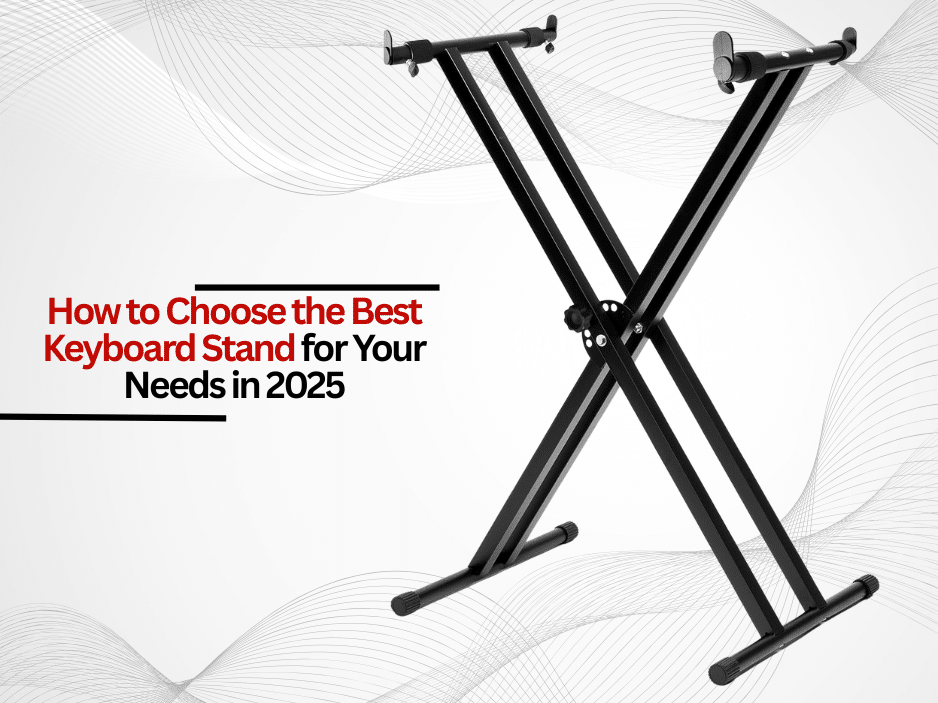
Selecting a keyboard stand in 2025 necessitates considering specific user needs, design trends, material advancements, and details like ergonomics, portability, and smart technology. This review highlights all the stand types, key considerations, features, and the most important ready-for-the-future technologies that will help musicians make informed decisions.
To know more, read: The Evolution of Piano Stands: From Fixed Frames to 2025’s Adjustable Solutions
Important Key Considerations
Adjustability:
Configuration of height and tilt should cater to the most comfortable playing position for users of various body types. The best options are hydraulic systems or spindle mechanisms for seated and standing positions. Independent adjustments can be beneficial for dual-tiered stands.
Portability:
Musicians who travel frequently will benefit from stands made of aluminum alloys or carbon fiber, as these materials are light. Sturdiness should not be compromised for weight saving, however. Convenience can be improved with quick release locks and foldable designs.
Durability and Build Quality:
High-density composites, anti-corrosion coatings, and reinforced joints provide enhanced durability. Heavy digital pianos or hybrid instruments should have a load capacity exceeding 150 lbs. Optimal resilience is offered with steel or hardwood frames.
Budget:
Compatibility is to consider the arrangement of the modular accessories, such as removable tiers or tablet holders, that should relate to the instrument’s configuration. Additionally, the dimensions of the keyboard, its weight, and the stand have to match. The affordable choices tend to skimp on quality materials, whereas the expensive ones specialize in features like the addition of memory presets or construction out of eco-friendly materials. Thus, a compromise on cost and lasting value is ideal.
Types of Keyboard Stands
X-Style Stands:
Lauded for their price and ease of folding. Their cross-shaped legs allow for compact storage, but fixed height settings control long-term use and limit stability.
Z-Style Stands:
Due to the Z-shaped outline, stands with these provide broader height adjust-ability to cater for different performers, making them ideal for multi-tasking performers. However, this adds bulk and makes them less portable than X-stands.
Table Stands:
These offer sleek, minimalist designs and built-in cable organization, which is perfect for home studios. While lacking adjustability, fixed design excels, focusing mostly on integration into the environment.
Tiered Stands:
Multi-level framework tailored to hold secondary keyboards or controllers, these are adored by live performers and producers. It is paramount to have crossbars to avoid unnecessary swaying.
Smart Technology Integration:
With Bluetooth functionality and app connection, preset height and angle stands are expected to be added. Posture bias feedback also becomes a norm for these long-session tools, and with proper sensors, these are sure to ease the strain placed on the body.
Sustainable Materials:
Constructing with a conscious using renewable resources such as reclaimed aluminum, bamboo, or even biodegradable polymers speaks to the ever-growing environmental considerations. These materials offer structural support without having to face undue ecological consequences.
Ergonomics Enhancements:
Additional features such as antifriction vibration-reducing layers, lower spine support add-ons, and specialized contoured coping pads for leveling in rest position all help to enhance the comfort and relaxation experienced while seated. Such features cater not just to professionals but to amateur players as well.
Conclusion
Keyboard stands in 2025 are best tailored to the most flexible, adaptive, and futuristic approach in design considering the balance of multi-functionality and strength. Each of the distinguished leaders in this particular sector—brands such as 5 Core, Roland, K&M, and Donner—has distinct solutions for all forms of needs and preferences. As the market undergoes evolution of advancements in smart technologies and sustainability, the foundations of it need to recenter on the same strong foundations: stability and ergonomic support. Aligning the features of the stand with the playing style of the musician helps offer musicians the assurance that the setup will adapt to their changing artistic needs.